Product Description
We are recognized as a successful manufacturers, distributors, wholesalers, traders and suppliers of
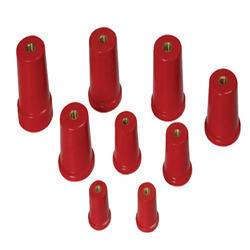
Conical Insulators in the market at the present scenario. The property that distinguishes an insulator is its resistivity; insulators have higher resistivity than semiconductors or conductors which make them very widely applicable. These are made available to the customers at industry leading rates and are provided as per the set industry norms and protocols as well.
Features: - Superb resistivity
- Low maintenance
- Good electrical protection
Applications: - Electrical applications
- Wrapping of electrical cables
- Thermal applications
Specification
| Color | Red |
| Material | DMC |
| Usage/Application | Electrical Purpose |
| Packaging Type | Box |
| Brand | RMW |
| Country of Origin | Made in India |
| Length | 4" |
... Read More
Superior Electrical and Mechanical PerformanceThis conical insulator features top-tier dielectric strength and surface hardness, providing safety and durability in demanding industrial settings. Its high mechanical strength and flame-retardant design ensure a long service life, even under extreme conditions. Engineered to work efficiently at 11 kV and up to 30 A, it supports reliable energy distribution and insulation for critical infrastructure.
Built for Extreme ConditionsResistant to UV, arcs, corrosion, and wide temperature fluctuations, the conical insulator performs dependably from -40C to +60C and under humidity levels up to 95%. Its glazed porcelain construction protects against environmental stressors, while the IP55 rating ensures resistance to dust and water ingress for secure, maintenance-free operation.
Easy Installation and ComplianceDesigned for bolt mounting with threaded stud connectors, installation is straightforward and secure. The insulator adheres to strict IEC 60383 standards, making it suitable for regulated industrial environments and confidently fits into existing single-phase setups requiring high voltage safety. Its standard dimensions facilitate fast replacement or integration into established systems.
FAQs of Conical Insulator:
Q: How is the conical insulator installed in industrial electrical systems?
A: The conical insulator features a threaded stud connector and is bolt mounted, allowing for secure attachment to electrical equipment or support structures. Its standard dimensions and single-pole design make integration straightforward for installers.
Q: What are the main benefits of using this conical insulator in high-voltage applications?
A: The insulator offers high dielectric strength (25 kV/cm), excellent arc resistance, and superior mechanical strength (20 kN), ensuring safety and long-term durability in 11 kV systems. Its glazed, flame-retardant porcelain construction provides resistance to UV, moisture, corrosion, and extreme temperatures.
Q: When should I choose this conical insulator for my project?
A: This insulator is ideal when you require reliable performance in harsh environments or need to comply with IEC 60383 standards. Its suitable for industrial settings, especially where high mechanical strength, UV resistance, and protection against electrical arcs and moisture are critical.
Q: Where is this conical insulator typically used?
A: Primarily used in industrial power distribution and equipment insulation, it is well-suited for substations, transformers, and outdoor installations in industries across India and similar global environments.
Q: What process ensures the reliability of this porcelain insulator?
A: This insulator is manufactured using high-quality porcelain subjected to precise glazing, ensuring a hard surface (Mohs 7) and robust protection against contaminants. Each unit undergoes rigorous testing for dielectric strength, IP55 protection, and compliance with international standards.
Q: How does the insulator perform under extreme environmental conditions?
A: It maintains efficiency and structural integrity in temperatures ranging from -40C to +60C and humidity up to 95%. The porcelain material resists corrosion, UV, and flame exposure, making it highly suitable for challenging industrial conditions.



 Send Inquiry




 Send Inquiry


 English
 Spanish
 French
 German
 Italian
 Chinese (Simplified)
 Japanese
 Korean
 Arabic
 Portuguese